Our Location
304 North Cardinal St.
Dorchester Center, MA 02124

For procurement managers and supply chain directors, choosing the optimal metal manufacturing process is a critical decision that impacts not only initial production costs but also the long-term structural reliability and performance of the end product.
When evaluating Forging vs. Casting, the decision goes far beyond cost-per-piece. It requires a deep dive into metallurgical behavior, mechanical integrity, and total cost of ownership. This guide provides expert engineering insights to help you make the right strategic sourcing decision for your upcoming project.
The core difference between forging and casting lies in how the material’s internal crystalline structure is formed.
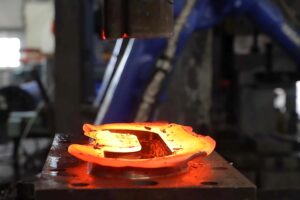
Forging uses thermal and mechanical energy to shape solid metal through die pressure. This process does not melt the material; instead, it refines the existing grain structure. The critical advantage of forging is continuous grain flow. The internal grain structures deform to follow the exact contour of the part, eliminating internal voids, gas porosity, and cooling defects. This results in superior mechanical integrity and unmatched resistance to impact and fatigue.
Casting involves heating metal to its liquid state and pouring it into a mold cavity, where it solidifies. As the liquid metal cools, it forms an equiaxed, non-directional grain structure. While casting allows for the creation of highly complex, organic geometries and internal cavities that would be impossible to forge, it is inherently susceptible to cooling-related anomalies such as shrinkage, dross, and microscopic porosity.
| Engineering Criteria | Forged Components | Cast Components |
| Grain Structure | Continuous, directional grain flow aligned to part geometry | Non-directional, equiaxed crystalline structure |
| Mechanical Strength | Highest tensile, yield, and fatigue strength | Moderate strength; dependent on alloy and cooling rate |
| Internal Defects | Virtually zero porosity or internal voids | Potential for subsurface porosity and shrinkage cavities |
| Design Flexibility | Best for simpler, high-stress shapes | Excellent for highly complex, thin-walled, or cored geometries |
| Machining Allowance | Minimal post-processing needed for closed-die forgings | Higher machining allowances often required to remove surface skins |
A common sourcing pitfall is evaluating a process based solely on the initial tooling and unit cost. To achieve true cost efficiency, a holistic approach to DFM (Design for Manufacturability) must be applied.
1.Tooling vs. Piece Price: Casting generally offers lower initial tooling costs and a lower piece price for complex designs. Forging tooling requires premium die steels capable of withstanding extreme pressures, representing a higher upfront investment.
2.Scrap Rates and Secondary Machining: Forged parts are closer to net shape and possess consistent material density, drastically reducing unexpected tool breakages and component reject rates during CNC machining.
3.Long-Term Structural Reliability: In high-stress or high-pressure applications, the failure of a cast component can lead to catastrophic system downtime. Forged parts offer a predictable lifecycle, reducing warranty claims and long-term liability costs.
Choose Forging When:
1.The component is safety-critical or subjected to high dynamic loads, severe fatigue, or impact stresses.
2.Structural reliability and a guaranteed absence of internal defects are non-negotiable.
3.Materials with higher mechanical property requirements (like high-strength alloy steels or aerospace-grade aluminum) are specified.
Choose Casting When:
1.The part geometry features intricate internal passages, complex cores, or large thin-walled sections.
2.You need to mass-produce oversized components (e.g., heavy equipment housings) that exceed typical forging press capacities.
3.You are working with materials that are difficult to deform in a solid state, such as certain cast irons or specialized high-nickel alloys.
A: Yes, in terms of tensile strength, fatigue resistance, and toughness, a forged version of a specific alloy will inherently outperform its cast counterpart. This is due to the grain refinement and elimination of internal porosity achieved through mechanical working.
A: Proper DFM analysis evaluates whether a part’s geometry can be optimized for closed-die forging to eliminate secondary CNC operations, or if it must be cast to achieve intricate internal channels, thereby balancing tooling investment against production throughput.
A: Yes. As a comprehensive engineering and manufacturing supplier, we analyze your product’s structural requirements, production volume, and budget to recommend and deliver the precise process—whether casting, forging, or precise post-machining—that yields the highest total cost efficiency.