Our Location
304 North Cardinal St.
Dorchester Center, MA 02124

In the world of high-precision manufacturing, the margin for error is often narrower than a human hair. This is where CMM inspection becomes the bridge between digital design and physical reality.
As engineering designs become more ambitious and geometries more complex, the methods used to verify these parts must evolve alongside the machines that cut them. For overseas buyers, the primary concern is the reliability of the quality control process.
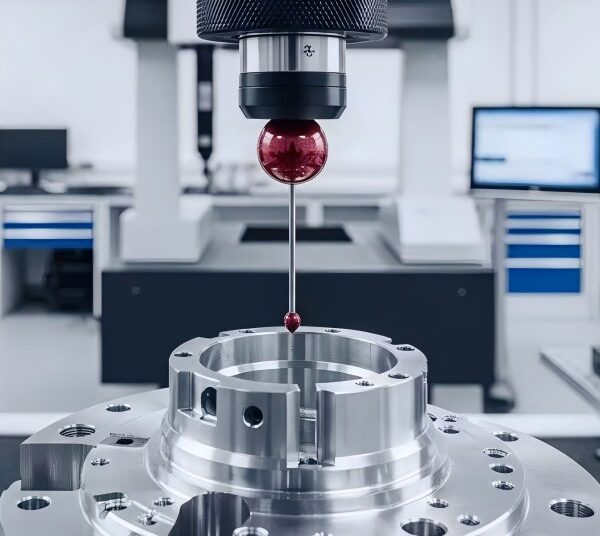
A Coordinate Measuring Machine, or CMM, is a specialized piece of metrology equipment designed to measure the physical geometry of a part with extreme accuracy. Unlike manual tools, a CMM uses an automated probe to record discrete points on the surface of a workpiece.
These points are mapped across the X, Y, and Z axes. This digital "twin" is then compared directly against the original CAD model, allowing for dimensional inspection that manual tools cannot replicate.
The necessity of CMM inspection stems from the reliance on Geometric Dimensioning and Tolerancing (GD&T). For critical components, knowing the diameter of a hole isn't enough; engineers need to know its "True Position" relative to other features.
From a buyer's perspective, CMM data identifies subtle dimensional drifts early. By detecting even a slight deviation in a First Article Inspection (FAI), a factory can adjust offsets immediately.
CMM catches tolerance stack-up issues early, ensuring complex parts fit perfectly upon delivery without the need for rework.
Detailed CMM reports act as a "birth certificate" for your parts, providing documented proof of precision for regulatory compliance.